
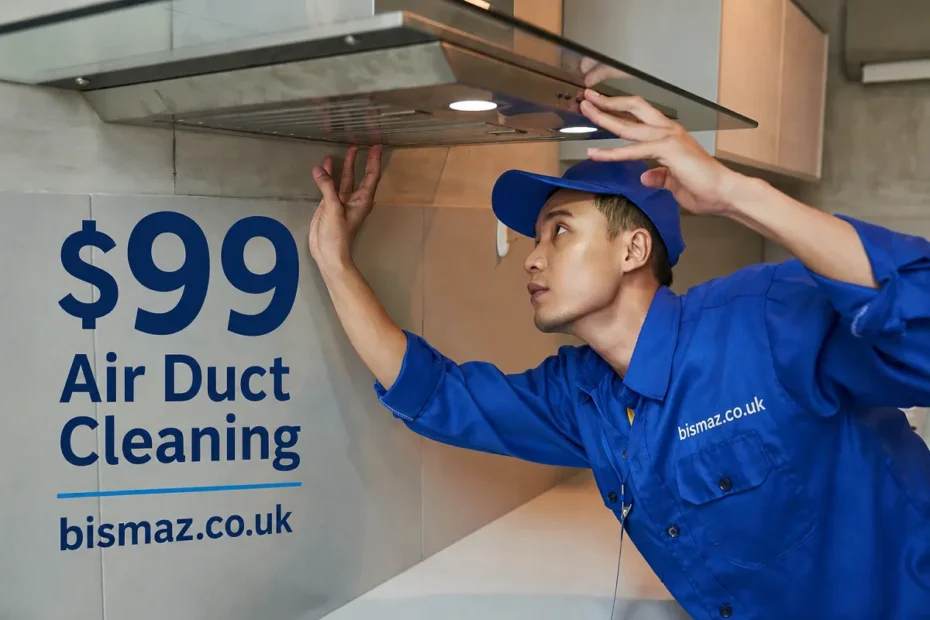
If you’ve seen a flyer, Facebook ad, or roadside sign advertising “$99 whole-home air duct cleaning,” you’re not alone, and your skepticism is warranted. These offers appear in nearly every U.S. metro, often promising same-week service and “unlimited vents.” The price is eye-catching by design. But here’s the honest answer most homeowners deserve before they pick up the phone: a thorough, code-compliant air duct cleaning cannot realistically be delivered for $99. The U.S. Environmental Protection Agency (EPA) estimates the typical cost at $450 to $1,000 per heating and cooling system, and the National Air Duct Cleaners Association (NADCA), the industry’s standards body, confirms similar figures. When the advertised price falls dramatically below that range, something is missing. Usually, it’s the actual cleaning. This guide explains what $99 typically buys, what a real cleaning involves, and how to evaluate any offer before money changes hands.
What $99 Air Duct Cleaning Usually Includes
Most $99 offers are structured as lead-generation tools, not full services. In practice, they generally cover one of three things:
A surface-level vacuuming of a limited number of vent covers (often 8-10), while the average home has 25-35 vents. The trunk lines, return ducts, registers, grilles, and coil are left untouched.
A walk-through inspection followed by aggressive upsells such as “deep cleaning,” “sanitizer treatment,” or “mold remediation” that can push the final bill past $800.
A “blow-and-go” visit using a portable shop-vac-grade vacuum (around 800-1,000 CFM), which doesn’t generate enough suction to perform actual source removal. NADCA-standard equipment pulls 5,000 CFM or more from a truck-mounted unit.
None of these scenarios match what professionals call HVAC cleaning. They’re either incomplete work or a setup for the upsell conversation that happens once the technician is inside your home.
Why the Price Can’t Add Up
A legitimate residential cleaning takes a two-person crew three to five hours, uses tens of thousands of dollars in equipment, and requires a trained Air Systems Cleaning Specialist (ASCS) certified by NADCA. Labor, fuel, insurance, and equipment maintenance alone exceed $99 for the typical job. Any company that genuinely delivers the work at that price is either operating at a loss or not delivering the work.
What a Real Air Duct Cleaning Actually Involves
The phrase “air duct cleaning” is a misnomer. NADCA’s position is that the entire HVAC system should be cleaned, not just the visible vents. A properly executed job includes:
Full system inspection
A certified technician evaluates the supply and return ducts, blower motor, evaporator coil, drain pan, and registers before quoting work.
Source removal cleaning
Using a truck-mounted negative-air vacuum, the system is placed under negative pressure so that dislodged debris flows in one direction, out of your home, not deeper into the ductwork.
Mechanical agitation
Pneumatic whips, rotary brushes, and air skippers physically dislodge debris that’s bonded to duct walls. Vacuum alone won’t remove it.
Component cleaning
Registers, grilles, diffusers, the blower, the coil, and the drip pan are cleaned individually. Skipping any of these leaves a reservoir of contaminants that re-circulates within days.
Post-cleaning verification
A reputable company will inspect with a borescope or camera and show you before-and-after evidence.
This is the work the EPA references when it cites the $450–$1,000 range, and it’s the work NADCA’s ACR Standard codifies.
When You Actually Need a Cleaning
Worth noting: the EPA does not recommend routine duct cleaning on a fixed schedule. It recommends cleaning when there is visible mold growth inside ducts, evidence of pests or vermin, or substantial debris that’s clogging registers or releasing particles into the home. Renovation dust, smoke damage, and post-flood remediation are other valid triggers. If a company tells you that “everyone needs annual cleaning,” that’s a sales position, not an EPA position.
How to Spot a Bait-and-Switch Before You Book
A few patterns show up reliably in problem operators:
Red Flag 1: No Written, Itemized Estimate
Refusal to specify exactly which components are included, by name, is the single most predictive warning sign. Legitimate companies will email you a scope of work before the truck arrives.
Red Flag 2: Per-Vent Pricing Buried in Fine Print
“Unlimited vents” with an asterisk leading to “up to 10 vents; additional vents $40 each” is the structural mechanism behind most upsells.
Red Flag 3: No Verifiable Credentials
Ask for the technician’s NADCA ASCS certification number, the company’s NADCA membership, state contractor license, and proof of liability insurance. NADCA maintains a public registry at nadca.com. If the company isn’t listed, that’s information.
Red Flag 4: Pressure to Decide on the Spot
“This price is only good today” is not how reputable trades operate. Quality contractors are booked weeks out and don’t need urgency tactics.
Red Flag 5: Mold Findings With Same-Day Treatment
A technician who “discovers” mold five minutes after arriving and offers to remediate it that afternoon for several hundred dollars is following a script. Mold remediation, per NADCA’s ACR Standard, follows the ANSI/IICRC S520 protocol. It’s a separate, planned process, not an impulse purchase.
What You Should Pay, and What to Ask
For a typical single-family home with one HVAC system, expect $450–$700 for a full NADCA-standard cleaning. Larger homes, multi-zone systems, or jobs involving documented mold push toward $1,000 or more.
Before booking, ask:
Can you send a written, itemized estimate listing every component being cleaned? What is your NADCA member number? Is the technician arriving on-site an ASCS-certified specialist? What vacuum equipment will you use, and what is its CFM rating? Will the price change once you arrive, and under what specific conditions?
A company that answers all five clearly is worth your time. A company that hedges is telling you what the visit will look like.
Frequently Asked Questions
Is $99 air duct cleaning ever legitimate?
Rarely. A few large operators occasionally run $99 promotions as loss-leader marketing tied to a longer service relationship (HVAC tune-ups, dryer vent cleaning). In those cases, the $99 typically covers a clearly defined, limited scope, and the company is transparent about it upfront. If the offer claims to be a full, whole-home cleaning at that price, the math doesn’t work.
How often should air ducts actually be cleaned?
The EPA does not endorse a fixed interval. Clean when there’s a specific reason: visible mold, pest infestation, heavy debris, post-renovation dust, or persistent unexplained respiratory symptoms tied to airflow.
Will duct cleaning lower my energy bills?
Possibly. ENERGY STAR data suggests cleaning can restore lost HVAC efficiency in systems with significant buildup, but the gains depend on how dirty the system was to begin with. It’s a side benefit, not the main reason to clean.
What’s the difference between NADCA-certified and “NADCA-trained”?
NADCA certification (ASCS) requires passing a proctored exam and maintaining continuing education. “NADCA-trained,” “NADCA-compliant,” or “follows NADCA methods” are marketing phrases that carry no verification. Always ask for a certification number.
Can dirty ducts make my family sick?
Dirty ducts circulate dust, dander, pollen, and, in humid climates, mold spores. For people with asthma, allergies, or compromised immune systems, that exposure matters. For healthy adults, the effect is usually modest. The EPA’s position is that duct cleaning has not been conclusively shown to prevent health problems, but it can reduce contaminant load when buildup is significant.
Bottom line:
$99 is the price of a phone call, not a cleaning. Treat the offer as an invitation to a sales conversation, ask the five questions above before agreeing to anything, and verify NADCA credentials independently. The few extra minutes of due diligence are the difference between a clean HVAC system and a frustrating afternoon with a tech you didn’t really want in your home.
For any suggestions or changes, please contact us.