
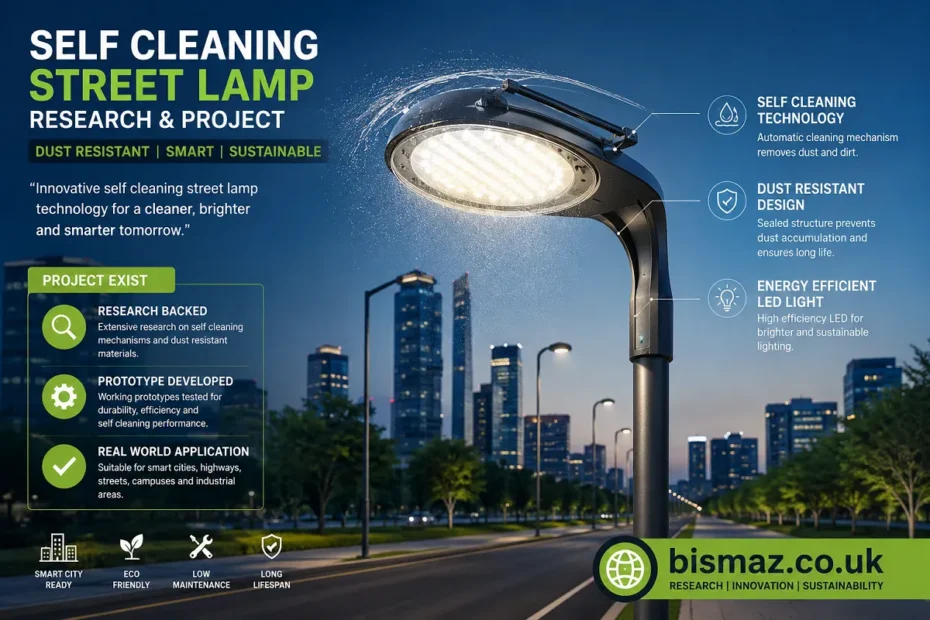
If you’ve been investigating whether self cleaning street lamp research and dust-resistant lamp projects really exist, the answer is a clear yes. These aren’t ideas of the future. They’re original engineering systems, currently deployed on roads, in deserts, at industrial sites, and across smart city pilot programs around the world. This article clearly explains what self-cleaning street lamp technology is, which original projects and products have been constructed, and what the science behind dust-resistant lamps looks like in practice.
Why Dust Is a Serious Problem for Street Lamps
Street lamps appear simple: a magnetic center, a fixture, a bulb. But in the actual world, they’re revealed to be one of the most dogged and destructive environmental forces.
Even a slender layer of fine particles on a lamp cover or solar panel can considerably reduce light output and energy concentration. In solar-powered systems, particularly, dust on the panel surface directly cuts how much energy is stored during the day, which means less light is provided at night.
The problem is most severe in:
- Desert and arid regions: sandstorms and arid blast deposit heavy particle weight readily.
- Construction zones: concrete dust and silica molecules coat surfaces within days.
- Industrial corridors: oil mist, chemical particulates, and heavy vehicle exhaust.
- High-pollution urban areas: smog and PM2.5 particles accumulate steadily over time.
In these environments, maintenance teams must clean lamps gradually, which costs money, requires specialized equipment, and, in some cases, causes disorder in traffic. For municipalities handling thousands of streetlights across wide areas, this becomes an important operational burden.
Does the Self Cleaning Street Lamp Research Project Actually Exist?
Yes, it occurs in multiple forms at the same time: academic research, patent filings, prototype testing, and commercially deployed items.
It’s worth being clear about one thing: there is no single company running a project called “the dust-resistant lamp project.” The phrase displays a broad field of research and development, not one lab or one initiative. What does exist is a robust and growing body of work across items of science, smart city engineering, and solar technology that has produced real, working keys.
Self-cleaning street lamp and dust-resistant lamp projects completely exist, symbolizing a promising advancement in urban infrastructure technology. Researchers and builders have already built multiple techniques, including hydrophobic coatings, electrostatic dust repulsion, mechanical wipers, and smart sensor-based cleaning systems, to address the unwavering challenge of outdoor lamp contamination.
The Core Technologies Behind Dust-Resistant Street Lamps
Hydrophobic and Nano-Coatings
The most foundational technique is surface treatment. Scientists use special coatings that block dirt using sunlight and water. When it rains, these layers cause dust to slide off automatically.
The science behind this is well-referenced. Research from The Hong Kong Polytechnic University, led by Professor Yang Hongxing, has invented a self-cleaning nano-coating that exhibits photocatalytic activity when activated by sunlight, causing water droplets to form a film that analyzes and adsorbs organic substances on the glass surface, which are then easily washed away by rainwater. The coating achieves a hardness of up to 8H after tempering, with a projected lifespan of up to 20 years and resistance to sandstorms and acid rain.
In solar panels and lamp covers, this technology has been evaluated effectively. A published study evaluating nano-coating thin films in unpleasantly climatic conditions found that coated panels averaged 64.7% higher short circuit current compared to uncoated panels, 2.8 A versus 1.7 A, demonstrating considerable progress in energy generation.
Electrostatic Dust Repulsion
Electrostatic cleaning uses electric fields to push away or move grime particles from lamp surfaces, clear electrodes are ingrained near the lamp cover, and a voltage generates an oscillating electric field that replaces and removes dust particles. This approach is especially well-studied in the context of solar panel cleaning research and is being adjusted for street lamp programs.
Mechanical Self-Cleaning Systems
For environments where inactive coatings aren’t enough, mechanical cleaning provides an active solution. Sresky’s Thermos series uses coarse bristle brushes with an automatic cleaning process that can run for up to four hours, removing dust and dirt from the lamp covering. The brush design on the guide rail side also protects solar panels from rain and dust interruption, while an intelligent anti-interference design ensures brushes retract mechanically when encountering obstacles to prevent damage.
Sresky’s self-cleaning solar street light was featured at LightFair. The frequency of the self-cleaning function can be programmed to automatically clean the solar panel up to six times per day, preserving the most favorable solar charging of the battery.
IoT and Sensor-Based Control
The most ultra-modern current systems don’t just clean on a timer; they clean when they need to. A study on IoT-based self-cleaning smart city street lighting proposes designs guided by green laws that combine sensors for real-time monitoring and mechanized cleaning schemes.
Smart scheduling allows cleaning and lighting cycles to be fully customized via IoT, with zero water usage through dry robotic brushing, critical in water-scarce regions.
Real-World Deployments: Where These Projects Are Operating
Desert and Industrial Environments
Gletscher Energy’s Stellar Series lights have been deployed in Middle Eastern deserts, where robotic brush arms clean panels daily, maintaining over 90% energy yield in spite of sandstorms. These off-grid units with LiFePO₄ batteries provide three to five nights of autonomy and incorporate motion sensors and IoT for smart management, with no routine maintenance required.
In a Sresky case study from a dusty industrial park in Peru, the Thermos Series self-cleaning system maintenance intervals were reduced to one to two times per year, completely removing the need for frequent access to hazardous industrial areas. Monocrystalline silicon solar panels with charging efficiency above 23% maintained high photovoltaic conversion effectiveness after automated cleaning, avoiding the 20 to 30 percent efficiency loss seen in conventional solar lights.
Agricultural and High-Pollution Zones
BOSUN Lighting applied self-cleaning solar street lights over 9 km of roads in Port Harcourt, Nigeria, where lamps are uncovered to dust, humidity, and oil mist from palm handling. The self-cleaning wipers reduced maintenance requirements by 90% while reducing CO₂ emissions by approximately 0.4 tons per lamp annually and improving safety by reducing nighttime accidents.
The Benefits of Self Cleaning Street Lamp Technology
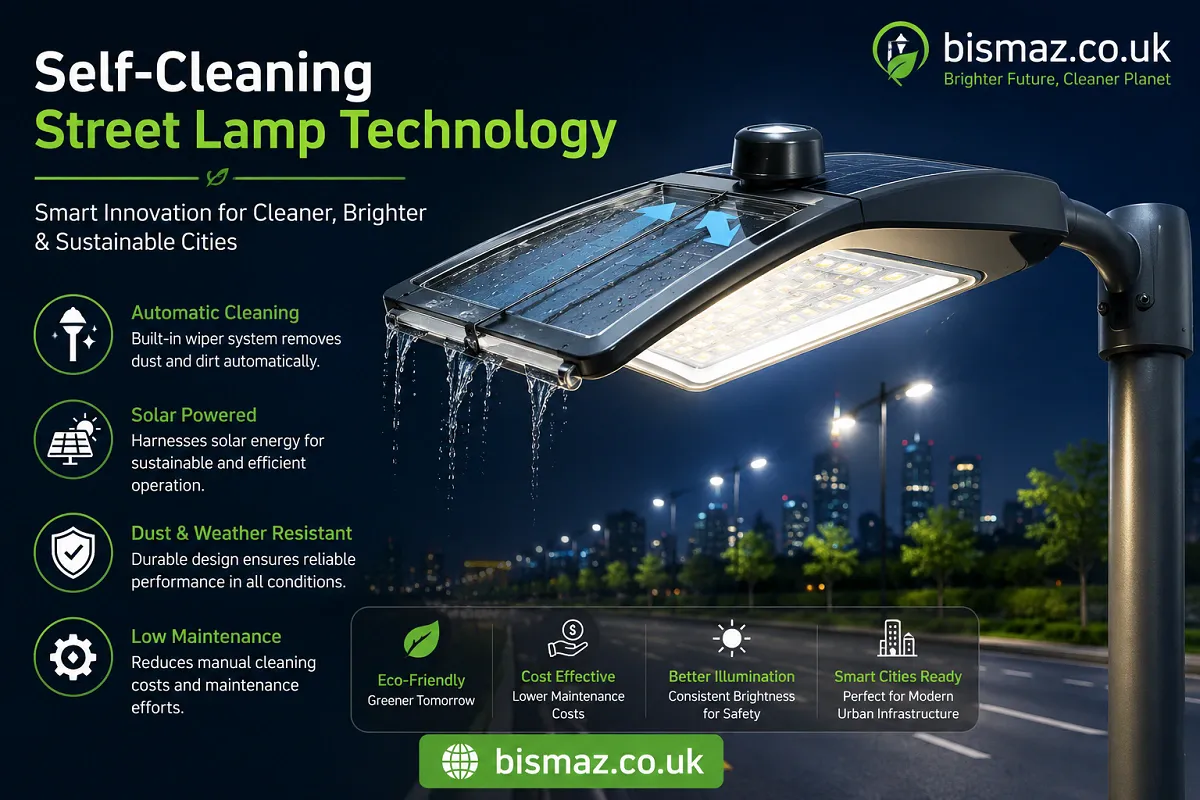
The value proposition of dust-resistant lamp systems extends beyond simply keeping lenses clean:
Reduced maintenance costs
Automated cleaning means fewer manual interventions. Maintenance crews don’t need to be dispatched as frequently, reducing both labor costs and safety risks associated with working at height or in traffic.
Sustained light output
Dust buildup on a lens can reduce effective lumen output by a significant margin over weeks. Self-cleaning systems maintain consistent illumination, which matters for public safety.
Higher solar energy yield
For solar-powered installations, clean panels mean better daytime charging and longer nighttime runtime, the two most critical performance metrics.
Longer service life
Less abrasive buildup on optical components and electrical systems reduces wear over time.
Sustainability alignment
Systems like BOSUN’s use less than 2% of daily energy for cleaning operations while maintaining 95% output efficiency.
Current Challenges the Research Is Still Addressing
No technology arrives fully solved. Researchers and builders are transparent about the remaining limitations.
Electrostatic procedures perform poorly in low-humidity environments, and mechanical systems may wear over time, even though designs are marketed with 10-year lifespans. High initial costs for coatings and IoT integration could hinder adoption in professional growth regions, and finer particles under 30 micrometers often require hybrid approaches.
Furthermore, the upfront cost of self-cleaning systems remains higher than that of traditional street lamps. The ROI case is powerful over a 5-10 year horizon, but municipalities with tight capital budgets may face barriers to adoption.
What the Future of This Research Looks Like
The field is advancing on several fronts simultaneously. Future research may synthesize electrostatic and mechanical technologies with AI for predictive cleaning and perfect cleaning cycles based on weather data. Expanding applications beyond solar-powered lamps to integrate with smart grids could broaden impact, aligning with global conservation goals.
Investigators are also investigating nanotechnology to develop surfaces that naturally remove dust without requiring mechanical cleaning, including nano-silica coatings, titanium dioxide photocatalytic layers, and antistatic polymer blends.
The longer-term goal is lamps that are genuinely maintenance-free for years at a time, not just cleaned automatically, but engineered so little adheres to them in the first place.
FAQs:
Q1: Do self cleaning street lamp research and a dust-resistant lamp project actually exist?
Yes, conclusive. Multiple commercial products are already deployed globally, including Sresky’s Thermos series and BOSUN Lighting’s systems. Educational research on hydrophobic nano-coatings, electrostatic repulsion, and IoT-integrated cleaning systems has been published in peer-reviewed journals. The technology exists across the full spectrum from laboratory research to real-world applications.
Q2: How do self-cleaning street lamps actually clean themselves?
Most systems use one or a combination of three methods: passive hydrophobic or nano-coatings that cause dust to slide off with rain or wind; active mechanical brush systems that operate on a schedule or in response to a sensor trigger; and electrostatic fields that repel charged dust particles from the lamp surface. Advanced implementations combine all three and are managed by IoT sensors that monitor dust buildup in real time.
Q3: Are self-cleaning street lamps cost-effective compared to standard lamps?
The initial installation cost is higher. However, the long-term economics tend to favor self-cleaning systems in dusty or remote environments, where manual maintenance is expensive, hazardous, or logistically difficult. Reduced maintenance frequency, longer panel efficiency, and longer component life cycles contribute to a favorable return on investment over a 5-10 year period.
Q4: Which companies are currently making self-cleaning solar street lights?
Sresky (China) is a well-documented manufacturer whose Thermos series was exhibited at LightFair 2023 and is deployed in deserts, industrial parks, and cold climates. BOSUN Lighting has documented deployments in Nigeria and West Africa. Gletscher Energy has reported deployments in the Middle East. The field is growing, with multiple manufacturers entering the market.
Q5: What is a hydrophobic nano-coating, and how does it prevent dust on street lamps?
A hydrophobic nano-coating is a microscopic surface treatment that causes water to bead up and roll off rather than spread. When applied to a lamp lens or solar panel, this rolling water carries dust and debris with it. Photocatalytic coatings (often using titanium dioxide) add a mechanism: sunlight activates the coating, which breaks down organic grime on a molecular level, making the surface easier to rinse clean.
Q6: Is self-cleaning street lamp technology suitable for all climates?
Most mature self-cleaning systems are designed to withstand wear across a wide range of climates. Sresky’s Thermos series, for example, is rated for operation between -20°C and 60°C. Some mechanical brush systems include antifreeze functions for cold climates. Passive nano-coatings are climate-agnostic but are most effective in environments with irregular rainfall to rinse away loosened particles. Fully arid environments typically require mechanical or electrostatic systems to compensate for the absence of natural wash-off.
Final Words
Self cleaning street lamp research is not a future general framework or a marketing term; it is an active, well-funded area of engineering with real-world results. Dust-resistant lamp projects genuinely exist: from university labs publishing peer-reviewed papers on superhydrophobic nano-coatings, to builders like Sresky and BOSUN Lighting deploying functional automated cleaning systems on streets in Peru, Nigeria, the UAE, and beyond.
The technology works by joining materials science, mechanical engineering, and smart sensor systems to address one of the most persistent and underappreciated problems in public infrastructure. The slow degradation of outdoor lighting due to dust accumulation. As costs decrease and smart city funding increases, self-cleaning street lamps are likely to move from specific deployments into mainstream municipal lighting.
For engineers, urban planners, procurement teams, and students researching this space. The foundation is solid, the products are commercially available, and the research pipeline is active.
For any suggestions or changes, please contact us.